
How to Write a Nursing Reflective Essay (Gibbs, Driscoll and Johns Models Explained)
Learn how to write a nursing reflective essay using Gibbs, Driscoll and Johns models. Includes step-by-step guide, examples, model comparisons, and expert nursing essay tips.
Reflective writing is one of the most distinctive and, for many student nurses, most challenging forms of academic work. Unlike a traditional essay where you argue a position or review literature, a nursing reflective essay asks you to look back at a clinical experience, examine what happened, explore your emotional response, and connect it to nursing theory and evidence. The result should demonstrate professional growth, not just storytelling.
This guide covers how to write a nursing reflective essay, how to write a reflective essay nursing style assignments, and how to write reflective essay in nursing submissions from start to finish, with a detailed explanation of the three most widely used reflective models in healthcare: Gibbs, Driscoll, and Johns. It includes a nursing reflective essay example for each model, a step-by-step structure, common mistakes to avoid, and expert tips on how to start a nursing reflective essay when you are staring at a blank page.
If you need a professionally written nursing reflective essay that uses your chosen model correctly and meets your university's exact requirements, get in touch with our team and we will match you with a qualified nursing writer.
What is a Nursing Reflective Essay?
A nursing reflective essay is a structured piece of academic writing that examines a real clinical experience through the lens of a recognised reflective framework. It is not a diary entry, a patient case study, or a factual account of events. It is a critical analysis of your experience: what happened, why it happened, what you felt, what you learned, and how you will apply that learning to your future practice.
Reflective practice is embedded in nursing education because the ability to critically evaluate your own actions is a core professional competency. Nurses are expected to reflect on errors, successes, ethical dilemmas, and emotionally complex situations throughout their careers. The reflective essay is the academic expression of that skill.
Reflective practice is a learner-centred strategy that positions you as an active participant in your own education, rather than a passive recipient of clinical instruction. The examiner reading your essay is not looking for a perfect clinical performance. They are looking for evidence that you can think critically about your actions and commit to ongoing professional development.
What Nursing Means to Me: Reflective Essay Considerations
Some nursing reflective essays, particularly those at the start of a program or tied to professional values modules, ask students to write about what nursing means to me reflective essay style prompts. These are still reflective essays and should still follow a structured model. The difference is that the experience you reflect on may be a formative or values-based event rather than a clinical procedure: your first day on placement, a moment of patient connection, or an experience that confirmed your decision to enter the profession.
Reflective Models of Nursing: A Guide for Nursing Students
Here is a comprehensive guide on the most common nursing reflective models used in undergraduate and postgraduate nursing programs. This serves as both a Reflective Practice Toolkit: Models of reflection and a Reflective Models of Nursing: A Guide for Nursing Students. Understanding each model before you begin writing is essential, because your reflective essay must follow your chosen framework throughout, not just mention it in the introduction.
A nurses' guide to using models of reflection generally recommends choosing one model and applying it consistently rather than mixing frameworks. Each model structures reflection differently, and switching midway through your essay produces disjointed, difficult-to-assess work.
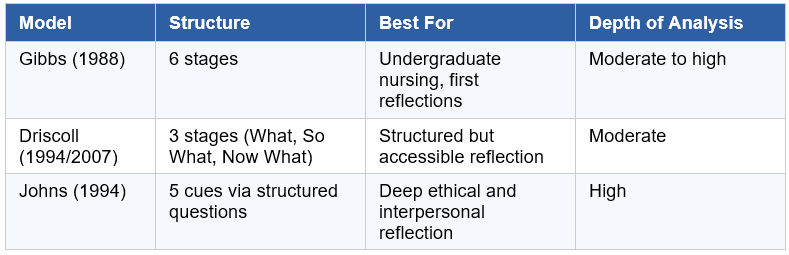
Each of these reflective models in healthcare has its own theoretical origins, strengths, and limitations. The sections below explain each model in depth, with a nursing reflective essay example for each.
Gibbs Reflective Cycle: The Complete Guide for Nursing Students
The Gibbs reflective cycle is the most widely used model in UK nursing education. Developed by Graham Gibbs in 1988, it is valued for its clear, accessible six-stage structure that guides students through a full cycle of reflection, from describing what happened to planning future action. Understanding what is Gibbs model of reflection and applying it correctly is a core expectation in most undergraduate nursing programs.
What is the Gibbs Reflective Model?
What is the Gibbs reflective model in detail? The Gibbs model of reflection consists of six sequential stages:
• 1. Description: What happened? Describe the event objectively without judgment.
• 2. Feelings: What were you thinking and feeling during the experience?
• 3. Evaluation: What was good and bad about the experience?
• 4. Analysis: What sense can you make of the situation? Link to theory and evidence.
• 5. Conclusion: What else could you have done? What have you learned?
• 6. Action Plan: If the situation arose again, what would you do differently?
Why Use Gibbs Model of Reflection in Nursing?
Why use Gibbs model of reflection in nursing specifically? Several reasons make it the preferred choice for many nursing educators:
• Why is Gibbs model of reflection good: its circular structure acknowledges that reflection is an ongoing process, not a single event.
• Why choose Gibbs model of reflection: the feelings stage explicitly validates emotional responses, which is especially important in emotionally intense nursing situations.
• Why is Gibbs reflective model good: the action plan stage links reflection directly to future practice, which satisfies NMC requirements for continuing professional development.
• The model is intuitive enough for first-year students yet structured enough for complex clinical scenarios.
What is the Main Idea of Gibbs Reflective Model?
What is the main idea of Gibbs reflective model? The central principle is that experience alone does not produce learning. It is only when experience is deliberately reflected upon, analyzed, and connected to future action that genuine professional development occurs. Gibbs frames reflection as a continuous cycle rather than a linear process, which mirrors the reality of clinical practice.
How to Write a Reflection Using Gibbs Model
How to write a reflection using Gibbs model, how to write reflective essay using Gibbs model, and how to write reflection using Gibbs model all follow the same six-stage structure. What is Gibbs reflection model in practice? It is the cycle of Description, Feelings, Evaluation, Analysis, Conclusion, and Action Plan applied to a real clinical experience. Here is how to use Gibbs model of reflection stage by stage, including a Gibbs model of reflection example showing approximate word count proportions:
• Description (roughly 10% of your word count): Set the scene. Where were you, what was happening, who was involved? Keep this factual and objective.
• Feelings (roughly 15%): Be honest about your emotional response. Anxiety, confusion, pride, and discomfort are all valid. Avoid generic statements like 'I felt nervous.' Be specific.
• Evaluation (roughly 15%): What went well? What did not? Acknowledge both positives and negatives, even if the experience was largely positive or largely negative.
• Analysis (roughly 30%): This is the critical thinking stage. Draw on nursing literature, clinical guidelines, and relevant theory to explain why things happened as they did.
• Conclusion (roughly 15%): Summarise your learning. What would you do differently? What has this experience confirmed about your practice?
• Action Plan (roughly 15%): Make this specific and measurable. Not 'I will communicate better' but 'I will attend the communication skills workshop offered by my placement unit in the next month.'
Nursing Reflective Essay Example Using Gibbs
Here is a brief nursing reflective essay example using Gibbs to illustrate how the stages translate to written content:
Description: During my second placement, I was asked to assist with the administration of medication to an elderly patient. I noticed the patient appeared confused and was unable to confirm his name clearly. I administered the medication under the supervision of my mentor but felt uncertain throughout the process.
Feelings: I felt anxious and unsure. I was concerned that the patient may not have had capacity to consent but was uncertain how to raise this concern with my mentor without appearing to undermine their judgment.
Evaluation: The medication was administered without incident, which was positive. However, I did not raise my concerns in the moment, which on reflection was not consistent with the NMC Code's requirements around patient advocacy.
Analysis: According to the Mental Capacity Act 2005, a patient lacking capacity must have a best interests decision made on their behalf. Research by Griffith and Tengnah (2017) highlights that student nurses often experience role conflict between deference to supervisors and professional advocacy obligations.
Conclusion: I learned that advocacy is not optional, even as a student, and that raising concerns respectfully is a professional responsibility rather than an act of insubordination.
Action Plan: I will discuss the NMC advocacy guidelines with my personal tutor and practise using assertive communication frameworks such as SBAR in low-stakes simulation sessions before my next placement.
For a full-length nursing reflective essay using Gibbs, a sample nursing reflective essay using Gibbs model, a nursing reflective essay sample, or an example of nursing reflective essay using Gibbs, our nursing essay writing service provides original, model-compliant essays across all stages of nursing training. Understanding what is Gibbs model of reflection in nursing is just the beginning of applying it well in academic writing is a different skill, and one our writers have across every level from first-year to postgraduate.
Driscoll Model of Reflection: A Comprehensive Guide
The Driscoll model of reflection, also referred to as Driscoll's model of reflection and the Driscoll model of reflection nursing framework, is one of the most accessible for student nurses, particularly those new to reflective writing. Developed by John Driscoll model of reflection in 1994 and updated in 2007, it uses three deceptively simple questions to structure a complete reflective cycle. It is widely referenced in nursing literature, including the Driscoll model of reflection journal article published in Senior Nurse, and is a popular choice for reflective journals, portfolio entries, and shorter reflective assignments.
What is Driscoll Model of Reflection?
What is Driscoll model of reflection? What is the Driscoll model of reflection? The Driscoll model is built around three trigger questions:
• WHAT? - What happened? Describe the experience.
• SO WHAT? - So what does this mean? Analyse the significance of the experience.
• NOW WHAT? - Now what will you do? Plan future action based on your reflection.
This is the Driscoll what so what now what model, also referred to as the Driscoll reflective model what so what now what, the Driscoll model what so what now what, the Driscoll model reflection what so what now what, the Driscoll reflection model what so what now what, the so what now what reflective model Driscoll, the what so what now what reflective model Driscoll, the Driscoll so what model, or simply the driscoll what model or Driscoll's what model. Regardless of how it is referred to, the underlying structure is the same three-question framework. A Driscoll what so what now what model diagram typically shows these three questions arranged in a simple linear or circular flow. A Driscoll model of reflection diagram and Driscoll model of reflection pdf can be found via your university library or your Trust's clinical supervision resources.
Driscoll 1994 and Driscoll 2007: What Changed?
There are two versions of the Driscoll model. The Driscoll model of reflection 1994, also cited as Driscoll model (1994), introduced the What, So What, Now What framework as a simple structured tool. The Driscoll model of reflection 2007, also referenced as Driscoll what model of reflection 2007, updated and expanded the framework with additional sub-questions under each trigger. What is Driscoll model of reflection 2007? It is the revised version of the 1994 model, providing more scaffolding for deeper analysis and making it more suitable for formal academic submissions. What is Driscoll reflective model overall? It is the three-question reflective framework — What, So What, Now What — that guides practitioners through structured reflection on clinical experiences. Nursing reflection using Driscoll model is common at both pre-registration and post-registration levels in UK nursing programs.
When referencing the model in academic writing, be specific about which version you are citing. Driscoll 1994 What So What Now What model and Driscoll model of reflection 2007 are not identical, and examiners will notice if you cite one but describe the other. Knowing how to reference Driscoll model of reflection correctly is important for academic integrity. Reflective models in nursing Driscoll is a frequently searched phrase precisely because students want to cite the model accurately. For Driscoll model of reflection citation purposes, the full references are:
Driscoll, J. (1994). Reflective practice for practise. Senior Nurse, 13(7), 47-50.
Driscoll, J. (2007). Practising clinical supervision: A reflective approach for healthcare professionals (2nd ed.). Bailliere Tindall Elsevier.
For Driscoll model of reflection Harvard reference format, the 2007 edition is most commonly cited in UK nursing programs. Always confirm with your institution whether Driscoll model of reflection reference should be in Harvard, APA, or Vancouver format. See our referencing guide for nursing students for formatting guidance.
Why is Driscoll a Good Reflective Model?
Why is Driscoll a good reflective model? Several features make it a practical choice for nursing students:
• Its three-question structure is easy to remember and apply consistently
• It works well for shorter assignments and portfolio entries where word count is limited
• The Now What stage directly emphasises actionable learning, which is a core NMC expectation
• It is sufficiently structured for academic assessment while remaining accessible to newer reflective writers
Driscoll Model of Reflection Advantages and Limitations
Understanding Driscoll model of reflection advantages alongside its limitations helps you decide if it is the right choice for your assignment:
• Advantages: simple structure, accessible for beginners, applicable to short and long reflections, compatible with clinical practice settings
• Limitations: the three questions can produce superficial reflection if not probed deeply enough; the 1994 version lacks the scaffolding of the 2007 update; it does not explicitly prompt ethical analysis as Johns does
Nursing Reflective Essay Using Driscoll Model: Example
Here is a brief nursing reflective essay example using Driscoll based on the 2007 framework; this serves as a Driscoll model of reflection 2007 example and a Nursing Reflection Using Driscoll Model in academic format:
WHAT? During a night shift, I observed my mentor respond to a patient who was verbally abusive due to dementia. My mentor maintained calm and used de-escalation techniques throughout the interaction, which resolved the situation without further incident.
SO WHAT? I had not seen such composure under pressure before and initially felt anxious. On reflection, I recognise that my mentor was applying person-centred care principles, understanding the patient's behaviour as a symptom of their condition rather than an intentional act. According to Kitwood (1997), dementia care requires practitioners to look beyond behaviour and respond to unmet emotional needs.
NOW WHAT? I will complete an online module on dementia-sensitive communication available through my Trust's learning portal and request to shadow further interactions of this nature with my mentor's agreement, with a view to developing my confidence in de-escalation techniques before my next placement.
For a full reflective essay using Driscoll model or a nursing reflective essay using Driscoll model written to your word count and university guidelines, see our nursing essay writing service.
Johns Model of Reflection: The Basics and Example
What is the Johns model of reflection? Developed by Christopher Johns in 1994 and refined in subsequent editions, the Johns model of structured reflection is the most philosophically rigorous of the three frameworks covered in this guide. It uses a series of structured cue questions to guide practitioners through a deep, multi-dimensional analysis of a clinical experience, with an emphasis on ethical and aesthetic knowledge
What is Johns Model of Reflection?
What is Johns model of reflection in terms of its structure? Unlike Gibbs and Driscoll, the Johns model of reflection does not follow a simple sequential list. Instead, it organises reflection around five types of knowledge drawn from Carper's (1978) patterns of knowing:
• Aesthetics: What was I trying to achieve? What were the consequences of my actions?
• Personal: What was I feeling? Did I act for the best?
• Ethics: Was this the right thing to do? What factors influenced my decisions?
• Empirics: What knowledge informed or should have informed my practice?
• Reflexivity: How does this experience connect to previous experiences? Could I have handled this better?
Johns Model of Structured Reflection Example
Here is a brief johns model of structured reflection example to illustrate how the framework translates to written reflection:
Aesthetics: I was assisting with a wound dressing for a post-operative patient who became distressed during the procedure. I aimed to complete the dressing efficiently while minimising the patient's pain. However, I focused more on the technical task than on the patient's emotional state and did not pause to acknowledge her distress verbally.
Personal: I felt task-focused and under time pressure. I was aware of the patient's distress but told myself that completing the dressing quickly was in her best interest. On reflection, this rationalisation prevented me from responding to her as a whole person.
Ethics: The patient's dignity and comfort should have been as much a priority as the technical completion of the dressing. I was applying a task-focused approach when a person-centred one was called for. This conflicts with the NMC Code's requirement to treat people as individuals.
Empirics: Evidence from McCabe (2004) highlights that task orientation in nursing communication leads to reduced patient satisfaction and increased anxiety. A more effective approach would have been to pause, make eye contact, and verbally acknowledge the patient's feelings before continuing.
Reflexivity: This situation reminds me of a similar incident in my first placement where I also prioritised task completion over patient communication. This suggests a recurring pattern I need to address actively through communication skills development.
Johns Model of Reflection Pros and Cons
Understanding johns model of reflection pros and cons helps you decide if it is the right fit for your essay:
• Pros: encourages deep ethical analysis; produces sophisticated, multi-dimensional reflection; well-suited to complex or ethically challenging experiences; valued at postgraduate level
• Cons: more complex to apply than Gibbs or Driscoll; the cue questions require careful interpretation; less suitable for shorter word counts or first-year students unfamiliar with Carper's frameworks
For a johns model of reflection essay example at full academic length, a johns model of reflection example applied to a specific clinical scenario, or a johns model of reflection nursing essay specific to your clinical placement experience, our writers are familiar with the Johns framework at undergraduate, master's, and doctoral level. The johns model for structured reflection is also used in johns model of reflection pharmacy programs and other allied health subjects, not just nursing, making it a versatile choice for healthcare students across disciplines.
Theories of Reflective Practice: Comparing and Contrasting Gibbs, Driscoll and Johns
Comparing and contrasting the three reflective models helps you justify your choice of framework in your essay introduction, which is a mark-worthy move that many students overlook.
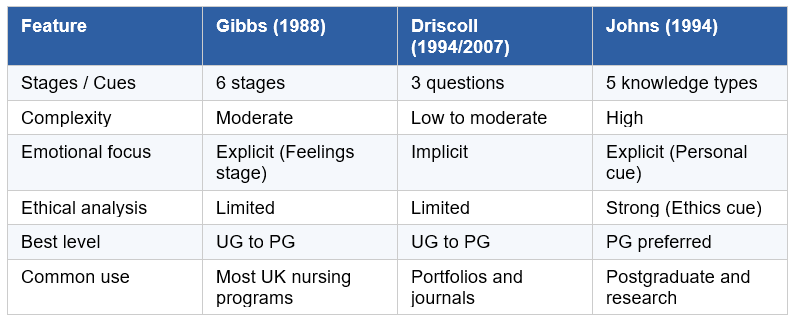
When choosing between models, ask yourself: How complex is my experience? How deep does my analysis need to go? How many words do I have? Gibbs suits most undergraduate assignments. Driscoll suits shorter, structured pieces. Johns suits experiences involving ethical complexity or interpersonal difficulty.
How to Write a Reflective Essay in Nursing: Step-by-Step
Knowing how to write a reflective essay for nursing and how to write a reflective essay in nursing submissions means understanding both the model and the academic expectations of reflective writing. Here is the full process from choosing your experience to submitting your essay.
How to Start a Nursing Reflective Essay
How to start a nursing reflective essay is one of the most common questions nursing students ask. The introduction of a nursing reflective essay should do four things:
• Briefly introduce the clinical experience you are reflecting on (without going into full detail yet)
• State which reflective model you are using and why you chose it
• Confirm that patient confidentiality has been maintained, usually by noting that names have been changed in line with NMC guidelines
• Outline the structure of the essay so the reader knows what to expect
Here is a nursing reflective essay introduction example using Gibbs:
"This essay reflects on a clinical experience encountered during my second-year placement in a surgical ward, using Gibbs' Reflective Cycle (1988) as a framework. Gibbs was selected because its structured six-stage approach provides clear scaffolding for examining both the practical and emotional dimensions of the experience. In accordance with the NMC Code (2018) and the Data Protection Act 2018, all patient and staff names have been changed to preserve confidentiality. The essay will move through the stages of description, feelings, evaluation, analysis, conclusion, and action planning."
How to Write a Good Reflective Nursing Essay: Body and Conclusion
How to write a good reflective nursing essay is ultimately about depth, honesty, and connection to evidence. Here are the key principles:
• Be specific: Generic reflections like 'I learned the importance of communication' score poorly. Describe the specific moment, the specific communication failure, and the specific evidence you have drawn on to understand it.
• Use first person: Reflective essays are written in the first person (I, my, me). This is an exception to standard academic writing conventions and is expected in reflective work.
• Link to theory throughout: Every stage of your essay (not just the analysis stage) should connect to nursing literature, clinical guidelines, or professional standards.
• Maintain confidentiality: Always anonymise patients and staff. A brief statement at the start of your essay confirming this is standard practice.
• Do not just describe: The description stage is only a small part of the essay. Spend most of your words on analysis, evaluation, and action planning.
Nursing Reflective Essay Examples and Samples
Looking at nursing reflective essay examples is one of the best ways to understand the standard expected in your own work. Whether you are searching for a nursing reflective essay example pdf, a sample nursing reflective essay, or a self reflection nursing reflective essay example, the most useful examples share three characteristics: they follow their chosen model stage by stage, they connect to current nursing literature, and they are written in a confident, analytical first-person voice.
What Makes a Strong Nursing Reflective Essay Example?
• A clear introduction that names the model, the experience, and the confidentiality statement
• Each stage of the model addressed in proportion to its importance (more words on analysis than description)
• References to nursing literature, NMC guidance, clinical guidelines, and relevant legislation
• A specific, measurable action plan rather than vague commitments to 'do better'
• Honest emotional engagement, particularly in Gibbs and Johns, without becoming purely personal or diary-like
Our nursing essay writing service provides full-length reflective essay samples written by qualified nurses and healthcare academics. You can also see how our writers structure a sample nursing reflective essay by browsing our essay samples page. For a deeper understanding of academic referencing in nursing essays, including how to reference the Driscoll and Gibbs models correctly, see our referencing styles guide.
Final Thoughts: Choosing the Right Reflective Model
Whether you use Gibbs reflective cycle, the Driscoll model of reflection, or the Johns model of structured reflection, the goal is the same: to use structured reflection to demonstrate professional growth, connect theory to practice, and show your examiner that you can think critically about your own clinical decision-making.
The best nursing reflective essay is not the one that describes a dramatic or exceptional clinical event. It is the one that analyses an ordinary experience with genuine depth, intellectual honesty, and a clear commitment to future development.
If you need expert support with your nursing reflective essay, whether that is choosing the right model, structuring your argument, or having the whole essay written by a qualified nursing professional, place your order today and we will match you with a writer who understands the NMC standards and academic expectations of your program.
Frequently Asked Questions
What is the best reflective model for nursing?
There is no single best model. Gibbs is the most commonly used in UK undergraduate nursing programs due to its accessible six-stage structure. Driscoll suits shorter pieces and portfolio reflections. Johns is preferred for postgraduate work or experiences involving ethical complexity. Your choice should match both your assignment requirements and the nature of the clinical experience you are reflecting on.
How long should a nursing reflective essay be?
This varies by institution and assignment brief. Most undergraduate reflective essays are between 1,000 and 3,000 words. Postgraduate reflective essays or dissertation-level reflective components can be 4,000 words or more. Always check your assignment brief and module handbook for the exact word count and weighting.
Can I write a nursing reflective essay in first person?
Yes. Reflective essays are an explicit exception to the general academic rule against first-person writing. Using 'I', 'my', and 'me' throughout a nursing reflective essay is expected and appropriate. Writing in the third person in a reflective essay would be incorrect.
Do I need to reference a nursing reflective essay?
Yes. A nursing reflective essay is still an academic piece of work and must be supported by references to nursing literature, clinical guidelines, the NMC Code, and relevant legislation. Every claim you make in the analysis stage should be underpinned by credible academic sources, formatted in the referencing style specified by your university.
How do I reference the Driscoll model of reflection?
Driscoll, J. (1994). Reflective practice for practise. Senior Nurse, 13(7), 47-50. For the 2007 update: Driscoll, J. (2007). Practising clinical supervision: A reflective approach for healthcare professionals (2nd ed.). Bailliere Tindall Elsevier. Use Harvard format for most UK nursing programs unless your institution specifies otherwise.
How do I maintain patient confidentiality in a reflective essay?
Always change patient names and any identifying details, and include a brief statement at the start of your essay confirming you have done so. A standard approach is: 'In accordance with the NMC Code (2018) and the Data Protection Act 2018, all identifying details have been changed to protect patient confidentiality.' Never include real names, dates, ward locations, or other information that could identify a patient.


